Showing posts with label comic process. Show all posts

Friday, June 6, 2014

Start Small: The Importance of Short Story Comics


When I was in high school, I worked on a comic series of mine called “Zack the Pyromaniac,” a story about a 20-something-year-old who suffered from mental issues and was recently framed for the murder of his roommates by his former best friend. His journey takes him from the deserts of Arizona to the streets of New York, where he befriends a homeless ex-Senator and the rich daughter of a banker, in order to uncover government conspiracies. He also wielded two knives and had the power of pyrokinesis because… it was supposed to be edgy and cool.

The plan was to map out the first season of this series into a 50-issue megapalooza, ending it around 1,000 pages. Without any direction beyond that, I furiously began work on my first pages, determined to bring to life what I thought was the most amazing comic idea ever conceived. But in the end, I didn’t manage more than seven fully watercolored and lettered pages before I gave up, discouraged because they looked like utter crap.
Dat anatomy yo.
Just like the vast majority of young kids who wanted to translate their dream stories into illustrated epics, Zack the Pyromaniac never saw completion. Hell, it didn’t even see half an issue of finish. Where did I go wrong? How did my incredible adventure crash before it even took off the runway?

One simple theory I have on why it failed is that… I had never really produced a single comic before in my life. I didn’t have a solid grasp on the medium of comics, and that I assumed my enthusiasm for this story would trump my lack of experience in producing sequential art. So how do you gain experience telling stories through comics, if you’re not working on a larger book? 

You create short story comics, self-contained stories that communicate an idea quickly and efficiently. This allows you to experiment and learn sequential art correctly, so that you are able to challenge larger and more complex bodies of work at a later date. 

So what are the benefits of creating smaller comics before larger epics?

1. You learn to finish things.

This is where the vast majority of people that are interested in doing comics end up failing. Most comic artists who want to do this for a living (or even as a hobby) are never able to finish a single comic, no matter how much time they put in. And oftentimes, it’s not because they can’t draw well, it’s because they set unrealistic goals for stories that, at the time they are trying to produce them, are beyond their ability.

Sit down and learn how to tell a story from panel to panel, then panel to page, then page to chapter, and you’ll start to discover what is working and what isn’t as you go. There’s no easy way around it, you just need to produce comics to get better at comics, and you don’t learn by talking about what’s going to happen in a series five years from now that you haven’t even planned out yet.

Try setting a goal of writing and drawing a two-page comic and give yourself a realistic deadline to complete it, possibly a week. If you find that at the end of the deadline that you haven’t even started, consider not pursuing that longer story of yours, since you already confirmed that you can’t do it yet.

Create a project that is manageable and is something that you can complete. Learn to finish things.
  
      2. You learn not to redo.

Many beginning comic artists get caught up with trying to make their first story perfect, so they keep redoing it and never make it beyond the first five pages. It’s frustrating, sure, but you know what? Your first few pages are going to look like crap no matter what you do, and that’s perfectly fine. Most people have to burn through 100 pages to get some understanding of the medium their working in, and the best way to do so is by breaking it in manageable, smaller chunks.

If you completed the two-page comic that I suggested before, put it away and don’t touch it ever again. Whatever you do, don’t redo that comic, as you’re only going to be wasting your time. Instead, consider a slightly more ambitious comic, maybe four-pages this time, and complete that one. Revisions are extremely important, of course, but redoing a comic that has flawed storytelling from the beginning will not help the finished project, no matter how good your drawing skills may become.

Do the work, don’t redo it.

      3. You learn to develop a workflow.

Some artists’ thumbnail their whole series front to back before doing any finished work, while some put ink to paper and draw straight through. There are people that will work in four-person teams to get the comics done, while sometimes you have one-man armies that can complete entire books alone. What works best for you?

When you’re putting together a comic, there are certain specifics that you need to familiarize yourself with before pressing too far. Are you aware of page bleed, live area, and standard page size for your comic pages? Do you know how quickly on average you can produce pages consistently? Do you have any idea if you’re going to publish it, how you’ll do it, or with who? And please don’t say Image, because you need to learn these things before you even craft a proposal to a publisher.

Most likely during your first comic, you’re going to make mistakes on the technical aspects. That’s fine, because you’ll be learning from these mistakes to apply to comics in the future. You’ll tighten up the speed that you do things and you’ll start to notice that your work will be more consistent from it, and you won’t feel pressured to go back and redo them as you would with a longer piece.

A while back, I made a blog post about my work process, but keep in mind that what works well for me might end up horrible for others. Find what works for you, develop that workflow until it becomes a process.

      4. You learn to become very precise in your storytelling.

Can you sit down and establish a premise, rising action, climax, and close it out, within a single page? If you can’t, chances are you’re not able to do this within 1,000 pages.

Break a story down into its essentials. Get the point across. Close it out without needless filler.

One of the problems that the person who wants to do a 3,000- page epic doesn’t realize is, why would you possibly need 3,000 pages when you can do it in less? What could possibly warrant that much space? Some of the greatest graphic novels of our time were completed within 150-200 pages, with stories ranging continents and time periods, and I bet you the writers/artists of these works never felt too constrained by their target page count.

Most likely, you can trim a story, and most likely it’ll flow better once trimmed.

      5. You’re able to explore genres and worlds that you wouldn’t be able to if you committed yourself to such a long project.

Referring back to Zack the Pyromaniac, if I had somehow managed to continue with that story and complete it, I wouldn’t have been producing any of the non-fiction and comics journalism that I do now. And quite frankly, there are a million other artists that do urban fantasy better than I ever could, but the same is not true about the genre I work in now.

By doing shorter comics, I had the opportunity to explore the horror and slice-of-life genres in the earliest parts of my illustration career, and I’m a better storyteller because of it. And because I allowed my other passions in real-world social issues and politics to seep into my work, my voice in the comic medium has become that much more focused.

As you explore shorter comics, allow yourself to discover certain themes that you enjoy that you can incorporate in future work. The theme of mental illness from Zack the Pyromaniac found its way into my single issue comic The Intellectual Ramblings of Samuel Flower, while the love of everyday life from that story weaved itself into my earlier travel comics like Seven Hours to Kill.

Step out of your comfort zone. If you are confident in your storytelling abilities, you should be able to translate that into type of story that you want. And I promise you, in a longer piece of work, you will have to use a variety of storytelling devices to tell a full and complete story.

Allow your shorter comics to evolve naturally, so that you can discover your voice in the medium.

6. You can publish these and build valuable credentials for when you try to publish a longer comic in the future.


If you keep working on shorter comics, eventually you’re going to end up with several that look pretty sharp. What do you do with them? You publish them, of course!

This is one of the most underrated benefits in putting together short story comics. When you finally do get around to pitching your larger book to publish, you already have past credentials that you can attach to your proposal.

A simple Google search of Comic Anthology Submissions 2014 (change date to current year) brings up a multitude of anthologies and literary journals that accept short comics. All you have to do is apply. It’s also a good way to learn how to work with an editor and handle feedback and revisions. This experience will be invaluable to you in the future, as you’ll know how to respond to critiques and edits proficiently, and have the know-how to put together your future book.

Not to mention, doing short comics gives you something to put together for a portfolio, if you choose you want to pursue a work in the Marvel/DC route, as they typically hire artists per staff and not by assignment.
I hope that this information can help convince you, if you’re a comic artist, about the benefits of starting small so that you can learn the craft before you find yourself overwhelmed. Just as you don’t expect an architect to craft a castle as their first assignment, don’t wander into something that’s too challenging for you without properly preparing yourself. You’ll thank yourself when you have the tools you need to craft your larger stories in the future.

In closing, if you’ve never produced short comics before and you’re a comic artist (or even if you’re not an artist), tell me what type of short story comics you would like to produce? If you have done shorter standalone comics in the past, what were they? Is there anything that you’ve learned from these attempts? Feel free to leave your take on this subject, and if you have any relevant work you’d like to link, please do so in the comments section below.

Thursday, January 3, 2013

My Comic Process


Throughout the time that I’ve been doing non-fiction comics, I’ve been asked quite a bit by writers, artists, editors, and a slew of other people about how I go from first sketches to finished product. It’s a very good question, mostly because when people think comics, they think that the medium is only able to tell fictional stories about superheroes and sorts.

People also have this idea that if you do tackle real events in the medium, that they are typically fall into the category of “political cartoons” and that the only type of storytelling is through satire. Perceptions also arise that because they are cartoons that they will appear as very quick sketches with no amount of detailed rendering at all. Well today I hope to try to answer some of these questions with somewhat of a brief tutorial on my process work.

This tutorial aims to do three things:
1.       Make it easier for future editors of primarily prose publications who have never worked with a comic artist before to familiarize themselves with a rough guideline of what to expect.

2.       To serve as a guide for beginning to advanced comic artists that are interested in experimenting with non-fiction/journalistic comics.

3.       To help writers who are interested in presenting their work in comics and providing suggestions and tools in order to allow them to do so.

As far as my process goes, I try to break it down into 3 major sections, with 8 minor categories. This is just a rough guideline that I’ve found to work most effectively for me in comics, but keep in mind could change depending on the person. It also effectively keep a project organized and I’m able to tell an editor exactly how far I am on a project at any given time.
Pretty simple to follow, yet essential when working with more than one person.

The following is a more detailed breakdown of the process of my comic making, hope you enjoy!

Writing                                                                                                    


-Research


Because my work is primarily creative non-fiction/journalism, a great deal of research goes into my comics before I even put pen to paper. This research can be a number of things: conversations with local people, taking photos of the surroundings, and interviews with professionals in a variety of fields.

I always tend to keep three tools on me at all times: a small pocket notebook, a camera, and a voice recorder.

Low tech and fits in your pocket. Not pictured is the point-n'-shoot camera I use.

I also take the advice from one of my writing professors back in university who would always say “Always keep a journal, because someday that journal might keep you.” In addition to this I’m an avid journal writer and typically write about a page a day about the events that happened in order to come back later when I do my novel work. Sometimes it’s the mundane things that you write about in journals that you’ll find more important later on that can really flesh out a story and add color to a scene. 

San Gabriel Road, Macabebe Pampanga. I used to walk
 this road back home almost everyday.
Also I try to be very involved in the subject that I’m writing about. For instance in the novel that I’m working on right now, it requires me to travel and live in three foreign countries and work in a field that I never went to school before or have had any real previous experience in. I have to not only learn how to teach, but I had to learn how to teach well. Remember all those papers that you used to have to write in high school about topics that didn’t really apply to you? Well, write what you know. And if you don’t know a subject, become involved with it so that you can understand it more. If you’re writing about baseball, maybe get on a field and actually learn how to play the game instead of making up information. 

Finally, people always ask me why I typically don’t draw on location. My main reason is that when I’m doing research, I need to be engaging in my subject matter rather than be a spectator. This means that I need to actively be talking to people and gaining their story, as this is where the camera comes in handy. I can get 100 reference shots of different door designs, local dress, the tiling that is used in someone’s home, the complexity of telephone wires in an area, all around the same time that it would take me to do a drawing. While everyone works differently, I feel that the drawing part happens when I get back to the drawing table, not in the field.

-Draft

Example of a script from page 24 of The American Immigrant
After all the initial research is talked about and recorded, I typically sit down and start writing a first draft in prose. The first part all I’m concerned about is dropping in important arcs of the overall story, doing straight writing without a concern for how any particular panel will look like. I go through and mark my reference where I have it that’s most relevant; along with how many pages I estimate a current story or chapter to be (subject to change, of course.)
After the first draft is finished, I go back and revise, starting to cut up my work and create breakdowns for each page. I keep in mind to try to left important breakdowns to end on the right page in order to create larger moments of closure on each page flip.

As I near the end of the writing, I go through and have this “1st draft” and script reviewed to make sure that it flows well. Once everything checks out at this point, we move onto the drawing…


Artwork                                                                                                  


-Thumbnails


Naw, not the ones attached to your hands, the sketch ones. My process for thumbnails has probably evolved the most over time than any other aspect of the art stage, originally from chicken scratches with pen on printer paper to now decent line and value studies in Photoshop aimed at around 10 x 15 inches. This is because I print my thumbnails out to the art size that I want to draw at, favoring a light table to make a transfer onto a clean piece of Bristol to complete my pencils faster and more detailed than without the transfer.

I also tend to make my thumbnails more detailed than a lot of comic artists, taking the time to make sure that everything visually flows and is set up at this stage before moving on. After completing my thumbnails I usually switch to another comic or artwork to let my thumbnails sit so I can go back and edit later. An extra hour spent on my thumbnails to fix corrections typically save me about 4 hours later down the road.
I’m also ok with breaking away from my draft a bit in order to get better flow and composition, but I’m always very careful to try to get exactly what I want at this point.


-Pencils


Done with planning, now onto the real drawing stage of a comic. At this stage I’m using my reference very liberally in order to pull things from my previous research to accurately describe real people that exist in the real world. This is where having a ton of photo reference helps as I should have a fairly sizable library at this point to draw from. I think overall my pencils tend to be a little less tight than a lot of other professional comic artists, but this is mostly because I’m also inking the work myself and I can work with these pencils as my guideline for this. At this point characters and environments are more fleshed out, textures are noted, and designs are pushed out a little more.
I also work at a larger size (11x17 or about A3 size on pre-lined bristol) in order to get in all the detailed work that I want that I might not be able to do at the target print size. This also helps eliminate any small shakes of the hand or other small errors that might be apparently if I was to draw target scale. The tools I use are pretty simple, just a mechanical pencil and a couple of H regular pencils with a kneaded eraser.


-Inks


Probably the most time consuming parts of my comics, because of the amount of rendering that I do with my inking. Using the same process as my penciling, I set up my light box to ink on another clean piece of Bristol board on top of my pencils. I used to be a crow quill and bottle ink guy (swore by the Hunt 102 nib) but as time passed and I found myself having to move often with my art supplies, I found pigment liners to suffice just as well. I’ve also moved away from spotting my fill blacks with a brush and just drop in my deep blacks with a black marker. Any mistakes I draw back into the page with normal correction fluid. People have asked if I’ve used a ruler for most of my work and honestly, I only use a T-square to lay in panel borders and such; I’ve mostly relied on drawing with my arm and locking my shoulder to get straight freehand lines. It takes practice but it’s very doable.
At this point I’m trying to put a tight final finish on my pages, making them essentially what I want them to look like if I was to print them exactly how they are at the time.


-Letters

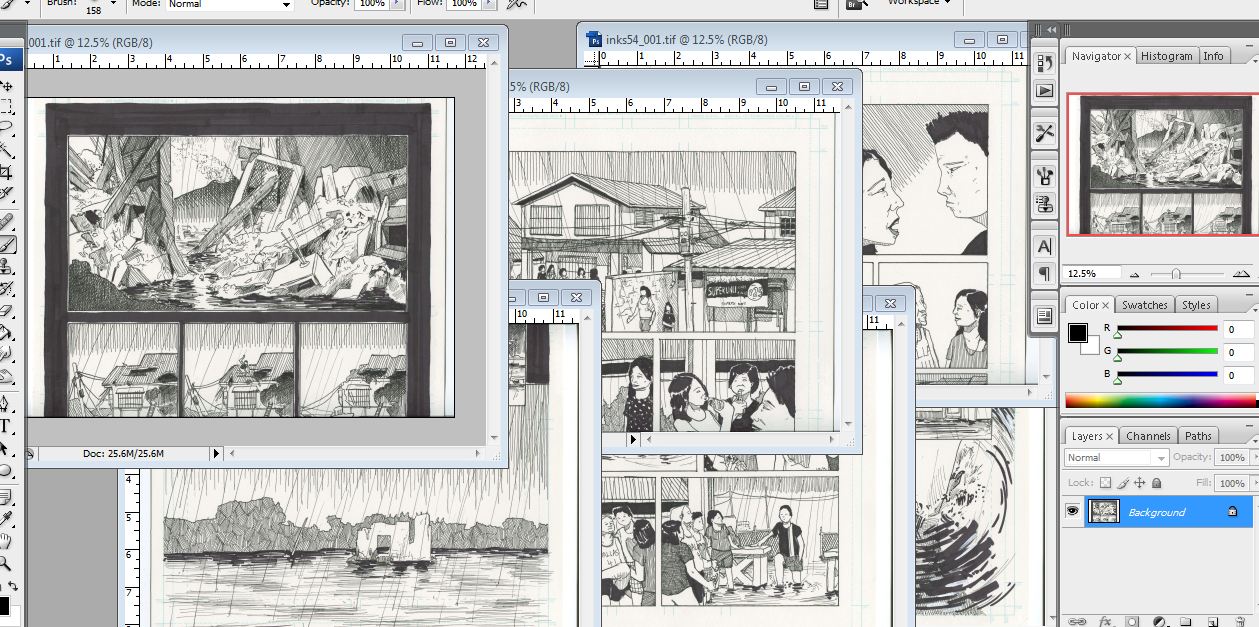
Now to bring everything back into the digital world! I go through and scan my inks in at 300 dpi and set up the files to target print size (6.625 x 10.25 inches) and create separate layers for the lettering. The font sets that I use in my comics are actually based on my handwriting that I built previously and scanned in later, as to try to get a handwritten font that closely resembles my drawing work. Besides that I also freehand my borders and bubbles for my comics to give it that sort of journal feel to it too. Since I often work in foreign language (I speak multiple languages but I’m only a native speaker in English) I often mark anything that appears in non-English with a <………….> to come back later with a trusted translator.

I also choose to do lettering digitally over traditionally for one main reason, for fact checking and edits later that I may have missed. This is where you see essentially the “2nd draft” of the comic emerge. Peer reviews are done and everything is caught up at this point, and finally…


Editing                                                                                                       


-Edits


This is where I get back with my editor and beta-readers in order to hash out problems with the dialogue and fact checking. This is where I aim to get a complete and final 3rd draft of the comic and prepare it to actually make it out to readers. I try to make sure that all my research is grounded with at least two sources for any major issue or quote, and this is where my translators come in and help to edit and make sure that my poor foreign language skills are touched up. Because most of the comic has been guided through every step of the way to this point, there isn’t much to do and not much is really changed at this point, but still extremely important.

This part takes wayyyyy too long...
 

-Post Production


Finally onto the last leg of the process. Once I’ve built the comics in photoshop and have everything compressed, I then bring the files into Adobe Indesign and prepare them into a nice handy .pdf for clients. Even though it seems like a simple process, if done wrong you can completely destroy the comic when it is to be printed (speaking from prior experience). I make sure that I have plenty of conversation with the editor at this point to make completely sure that the file is exactly as what they want it to be. Mission accomplished.
 

Conclusion


I hope that this sort of tutorial helps people that are interested in producing and publishing creative non-fiction and journalist comics. It is a medium that has slowly been gaining traction as of lately and I deeply hope that it changes the minds and opinions of people who perceive comics as some sort of joke for the funny pages. If this tutorial helps you at all or you have further questions please let me know, and if this helps you in producing any comics like this be sure to post a link in the comments section as I’d love to read your work. Anyways good luck, fighting!