Showing posts with label comics journalism. Show all posts

Thursday, August 4, 2016

Myanmar's Rohingya Refugees comics journalism up on The Nib

https://thenib.com/myanmar-s-rohingya-refugees?id=erik-thurman&t=authorEarlier this year, I went to India to investigate one of the largest exodus of refugees of our times, where the Rohingya Muslim minority of West Myanmar (Burma) are escaping genocide from their ancestral homeland in Rakhine state.

And now that Nobel-laureate Aung San Suu Kyi and her Party have ushered democracy into the Southeast Asian country, is a path to peace finally in sight?

Or will the new Myanmar government continue to turn its back to ethnic cleansing?

New comics journalism by mine is finally up on the rebooted Nib. Click the image on the left to be taken there.

Wednesday, June 15, 2016

Chile. June 2017. It’s happening.


Thanks everyone for coming out on Sunday a couple weekends ago for BBQ! It means a lot to share good food and drinks to mark my 5th year anniversary away from the USA. Definitely had a great time with you all!

So a lot of you might have known that I’ve been making plans to go to South America for some time. But this is the first time I'm announcing a hard date.

Chile is finally going to happen exactly one year from now.

Sunday, July 26, 2015

Eat More Comics: The Nib's 2nd Anniversary Print Anthology out on Kickstarter!

https://ksr-ugc.imgix.net/projects/1960524/photo-original.jpg?v=1436931620&w=1024&h=768&fit=crop&auto=format&q=92&s=1611d089a168c962f8553e4346318232


Since The Nib launched back in September 2013, they've lead the charge in publishing some of the best comics journalism, political cartoons, non-fiction, and humor throughout the internet. And now they are coming out with a 300 page hardcover book featuring their best work they've selected from the 2,000+ comics they've put out since The Nib's inception. But they need your help on Kickstarter in order to make this book a reality. Included in the book, you'll find--

Hilarious comics from Gemma Correll · Rich Stevens · Zach Weinersmith · Jon Rosenberg · Emily Flake · KC Green

Political cartoons from Tom Tomorrow · Matt Bors · Jen Sorensen · Matt Lubchansky · Ann Telnaes · Brian McFadden · Liza Donnelly· Ruben Bolling · Ted Rall · Keith Knight

Journalism by Andy Warner · Josh Neufeld · Susie Cagle · Emi Gennis · Ryan Alexander-Tanner · Eleri Harris · Erik Thurman · Jess Ruliffson · Sophie Yanow · Roxanne Palmer

Comic essays by Ron Wimberly · Erika Moen · Sarah Glidden · Wendy Macnaughton · Mike Dawson · Lucy Bellwood · Whit Taylor  · Lisa Eisenberg · Eroyn Franklin · JJ McCullough

More? Yes, more: Kate Leth · James Sturm · Shannon Wheeler · Scott Bateman · Eleanor Davis · Maki Naro · John Leavitt · Kendra Wells

With 18 days to go, we still need to raise about $20k in order to reach our goal to see this book hit the printers and be out by the time SPX rolls around in September. Check out the Kickstarter now!

Saturday, May 2, 2015

Umbrella Black-out has been translated into Chinese


Last October, I went to Hong Kong to cover part of the Umbrella Revolution, hoping to spread a bit more of the reality that was taking place in the protests. And fortunately today, a bit of that message will be able to reach a larger audience now that it's been translated into Chinese.

Click the link below, and thanks to pao-pao.net for the excellent translation work!

https://pao-pao.net/article/432

Monday, April 27, 2015

Short listed for the Reportager Award 2015


After hundreds of entries were made their way through a series of judging, my graphic memoir The American Immigrant has made the short list for the Reportage Award 2015. The award, sponsored by Reportager and Moleskin, encourages new, existing and emerging talent and projects in the area of reportage and documentary drawing. It also seeks out original projects, which are journalistic and documentary in nature and are created from original primary research sourced on location by the artist.

In addition to the award and grant, Moleskine reserves the right to commission the winning artist/journalist to report on an event (timing, location, and event to be at Moleskine's discretion). Travel expenses, accommodation, and subsistence up to the value of £1700, will be available.

The exhibit will be at the University of the West of England F Block Gallery (Bower Ashton Campus) in Bristol, UK, from May 8th to the May 15th (save for the 11th, which it will be open for private viewing).

This is definitely not a show to miss, especially if you're a huge fan of documentary drawing and comics journalism. I'll be featuring quite a few never-before-seen pages from my first book, so you have no excuse to not make it if you're living in the UK!


Thursday, March 26, 2015

My New Portfolio for Comics Journalism

 https://www.dropbox.com/s/tjonva4r34rz9uk/erik_thurman_portfolio2015.pdf?dl=0

It's about that time that I've dug out enough new work to showcase in a portfolio for potential clients, editors, and readers of my work. Click the image above to view it, and also be sure to check out the comics tab on the left in order to view many of these stories in their entirety!

Sunday, February 15, 2015

New comic on The Nib: Umbrella Blackout.

My new comic up on The Nib places a spotlight on the Umbrella Movement to show how governments around the world are increasingly turning to alternative measures in order suppress dissent, beyond resorting to tear gas and rubber bullets.

https://medium.com/the-nib/umbrella-blackout-chinas-war-on-digital-activism-d6e6265ee45e

 Click the image above for some quality researched comics journalism.

Tuesday, September 30, 2014

Working with the The Nib on Medium.com

About a year ago, a new digital platform called The Nib on Medium.com opened up its binary doors online. This publication, led by Matt Bors and Eleri Harris, seeks to promote the best in comics journalism, political cartoons, humor, and non-fiction that is being produced by some of the most talented author/artists today. Words with pictures, kicking butt. And recently, I was contacted by one of their editors to see if I'd be interested in collaborating with them on stories about current events and social issues.

My first story up takes us to the Gulf nation of Qatar, in which migrant workers from all over South Asia flock to in order to make a living. But that living comes at a price...

A Debt-To-Slave Pipeline is Building You a World Cup Stadium now on The Nib!
Click the image above to get an in-depth view about the conditions that migrants workers have to face over in Qatar, along with the key players that continue to perpetuate this modern-day slavery. Be on the lookout for more of my comics journalism in the future and check out some of the other awesome comics on The Nib!

Saturday, June 14, 2014

The American Immigrant: Philippines


Last year, American student loan debt for the first time in history exceeded $1 trillion dollars, becoming the number one form of financial liability in the USA. Young people who were promised the same standard of living as their parents now find themselves jobless in an economy that doesn’t want to pay a living wage. Many are choosing to move back with parents and are delaying marriage and owning property. Others are abandoning their country altogether. The American Immigrant: Philippines is part one of a graphic memoir trilogy that follows myself, Erik Thurman, as I work as a young migrant teacher traveling the world in search for solutions to this growing unaffordability and inaccessibility of public education.

With work scarce in the US, I travel to Southeast Asia to be reunited with my Filipina fiancée of three years, while being pressured by our in-laws towards a quick marriage. In order to stay within the Philippines and have my visa supported, I take on an unpaid internship working at a rural high school.

  
Somewhat disgruntled by my former education and bitter that I'm not working in a field that I studied for, I find the work as a teacher to be overbearing, to say the least. As I settle into my new Philippine life, I begin to uncover many parallels between Filipino and American public schools and experience where both systems are failing. And amid growing trouble with my relationship at home and my work at school, I find the struggles of my students to be not unlike mine, and rediscover a love for education that I thought was all but lost.


The American Immigrant: Philippines, already nominated for the Reportager Award, merges the hard journalism from Joe Sacco’s Palestine with Marjane Satrapi’s autobiographical Persepolis in order to tell the struggles our young generation faces around the globe to inspire positive change in education. Join me in this adventure that spans worlds, as I bring you a tale of romance and adversity that will kindle a passion for our public school systems. The book hopes to find a global release in the near future, so stay tuned for updates as they come. 


Wednesday, January 22, 2014

The Art for The American Immigrant is Finished!

It's been about a week since I posted any updates here on the blog, but finally I have great news on the graphic novel that I've been working on for the past 2 1/2 years...

The art is done.

This doesn't mean by a long shot that I'm finished with the whole book, there's still plenty to do until it's time to publish it. I still have about 20 more pages to finish up the lettering on a second pass, beta-readers are taking care of feedback for a 3rd pass through the whole book. Beyond that, I'm hiring a professional editor soon to copy-edit and fact check the entire manuscript before sending it off to agents. And that's not the only thing that's going into this book...

Coming up during February, I'm going to the Philippines for 10 days in order to do a detailed account of the state of education within the country to put into the graphic novel. I'm hoping to inject about 30 pages of prose into the back of this book, though still working out the contents of what I'll include at this time. I'll be traveling to Manila, Pampanga, and Bulacan during my stay, so let me know if you're in those areas!

Expect more frequent updates to this site and new material, 2014 is going to be a big year.


Thursday, July 4, 2013

From Vikings to Asians: Snapshot of Comics from Four Years Ago...

First off, Kim Bellware did an excellent write-up at The Huffington Post about a project in Chicago called "The Open Key." Featured there is one of my illustrations that I did for them about a month back. Check it out. Go. Now.

Anyways recently when I was digging through a lot of older artwork, I came across a comic that I did back in university four years ago. In the beginning illustration class that I was taking at the time, our instructor had us do weekly comic strips in preparation for our final, a two page comic based on anything that we liked. During that time I had just discovered Frank Miller in his gritty dark style of comics. I ate it all up, anything that had to do with high contrast violent scenes about fictional characters and fictional settings. And text? Pfft don't need it, needs more action all the time. That's how The Storm was born, my two page final for that class.


It was around that time that I was still experimenting with the direction I wanted to take with my art. Some of my biggest inspirations at the time were James Jean, Chuck Close, Andy Warhol, and most of the artists from the studio Massive Black. None of these were really comic artists at all. Comics were something that I really enjoyed, don't get me wrong, but I had my mind set after graduation to produce work in visual development for games and film. I was still determined to produce work that would reach and communicate to people, but I had never really gave thought that non-fiction is also very viable to tell the stories that I wanted.

Cut to the present and you have my most recent comic that was in the Cartoon Picayune in their latest issue, the Hard Work issue. If you haven't checked it out yet, you can see a larger version here on my site.

In the past 4 years since I had done The Storm, I've had the incredible experience to travel to six countries outside of my own.  This had a very profound effect on my current work, which has now shifted to almost entirely non-fiction comics and comics journalism. Most of my inspirations now for art and comics includes Joe Sacco, Marjane Satrapi, Josh Neufeld, Dan Archer, and Sharad Sharma, not to mention a plethora of other prose non-fiction writers and journalists. Information started to engulf my work, giving it a lot more complexity than it had before, and started to communicate the messages that I wanted to say when I was in university but didn't know how.


All in all, I'm happy about the progress in the past four years and the next four should be even more exciting. By that time I'll most likely have two parts of The American Immigrant out and on shelves.

Also for any readers of the blog that also have had an evolution in their work over time, please feel free to comment, don't be shy! Fighting!

Thursday, January 3, 2013

My Comic Process


Throughout the time that I’ve been doing non-fiction comics, I’ve been asked quite a bit by writers, artists, editors, and a slew of other people about how I go from first sketches to finished product. It’s a very good question, mostly because when people think comics, they think that the medium is only able to tell fictional stories about superheroes and sorts.

People also have this idea that if you do tackle real events in the medium, that they are typically fall into the category of “political cartoons” and that the only type of storytelling is through satire. Perceptions also arise that because they are cartoons that they will appear as very quick sketches with no amount of detailed rendering at all. Well today I hope to try to answer some of these questions with somewhat of a brief tutorial on my process work.

This tutorial aims to do three things:
1.       Make it easier for future editors of primarily prose publications who have never worked with a comic artist before to familiarize themselves with a rough guideline of what to expect.

2.       To serve as a guide for beginning to advanced comic artists that are interested in experimenting with non-fiction/journalistic comics.

3.       To help writers who are interested in presenting their work in comics and providing suggestions and tools in order to allow them to do so.

As far as my process goes, I try to break it down into 3 major sections, with 8 minor categories. This is just a rough guideline that I’ve found to work most effectively for me in comics, but keep in mind could change depending on the person. It also effectively keep a project organized and I’m able to tell an editor exactly how far I am on a project at any given time.
Pretty simple to follow, yet essential when working with more than one person.

The following is a more detailed breakdown of the process of my comic making, hope you enjoy!

Writing                                                                                                    


-Research


Because my work is primarily creative non-fiction/journalism, a great deal of research goes into my comics before I even put pen to paper. This research can be a number of things: conversations with local people, taking photos of the surroundings, and interviews with professionals in a variety of fields.

I always tend to keep three tools on me at all times: a small pocket notebook, a camera, and a voice recorder.

Low tech and fits in your pocket. Not pictured is the point-n'-shoot camera I use.

I also take the advice from one of my writing professors back in university who would always say “Always keep a journal, because someday that journal might keep you.” In addition to this I’m an avid journal writer and typically write about a page a day about the events that happened in order to come back later when I do my novel work. Sometimes it’s the mundane things that you write about in journals that you’ll find more important later on that can really flesh out a story and add color to a scene. 

San Gabriel Road, Macabebe Pampanga. I used to walk
 this road back home almost everyday.
Also I try to be very involved in the subject that I’m writing about. For instance in the novel that I’m working on right now, it requires me to travel and live in three foreign countries and work in a field that I never went to school before or have had any real previous experience in. I have to not only learn how to teach, but I had to learn how to teach well. Remember all those papers that you used to have to write in high school about topics that didn’t really apply to you? Well, write what you know. And if you don’t know a subject, become involved with it so that you can understand it more. If you’re writing about baseball, maybe get on a field and actually learn how to play the game instead of making up information. 

Finally, people always ask me why I typically don’t draw on location. My main reason is that when I’m doing research, I need to be engaging in my subject matter rather than be a spectator. This means that I need to actively be talking to people and gaining their story, as this is where the camera comes in handy. I can get 100 reference shots of different door designs, local dress, the tiling that is used in someone’s home, the complexity of telephone wires in an area, all around the same time that it would take me to do a drawing. While everyone works differently, I feel that the drawing part happens when I get back to the drawing table, not in the field.

-Draft

Example of a script from page 24 of The American Immigrant
After all the initial research is talked about and recorded, I typically sit down and start writing a first draft in prose. The first part all I’m concerned about is dropping in important arcs of the overall story, doing straight writing without a concern for how any particular panel will look like. I go through and mark my reference where I have it that’s most relevant; along with how many pages I estimate a current story or chapter to be (subject to change, of course.)
After the first draft is finished, I go back and revise, starting to cut up my work and create breakdowns for each page. I keep in mind to try to left important breakdowns to end on the right page in order to create larger moments of closure on each page flip.

As I near the end of the writing, I go through and have this “1st draft” and script reviewed to make sure that it flows well. Once everything checks out at this point, we move onto the drawing…


Artwork                                                                                                  


-Thumbnails


Naw, not the ones attached to your hands, the sketch ones. My process for thumbnails has probably evolved the most over time than any other aspect of the art stage, originally from chicken scratches with pen on printer paper to now decent line and value studies in Photoshop aimed at around 10 x 15 inches. This is because I print my thumbnails out to the art size that I want to draw at, favoring a light table to make a transfer onto a clean piece of Bristol to complete my pencils faster and more detailed than without the transfer.

I also tend to make my thumbnails more detailed than a lot of comic artists, taking the time to make sure that everything visually flows and is set up at this stage before moving on. After completing my thumbnails I usually switch to another comic or artwork to let my thumbnails sit so I can go back and edit later. An extra hour spent on my thumbnails to fix corrections typically save me about 4 hours later down the road.
I’m also ok with breaking away from my draft a bit in order to get better flow and composition, but I’m always very careful to try to get exactly what I want at this point.


-Pencils


Done with planning, now onto the real drawing stage of a comic. At this stage I’m using my reference very liberally in order to pull things from my previous research to accurately describe real people that exist in the real world. This is where having a ton of photo reference helps as I should have a fairly sizable library at this point to draw from. I think overall my pencils tend to be a little less tight than a lot of other professional comic artists, but this is mostly because I’m also inking the work myself and I can work with these pencils as my guideline for this. At this point characters and environments are more fleshed out, textures are noted, and designs are pushed out a little more.
I also work at a larger size (11x17 or about A3 size on pre-lined bristol) in order to get in all the detailed work that I want that I might not be able to do at the target print size. This also helps eliminate any small shakes of the hand or other small errors that might be apparently if I was to draw target scale. The tools I use are pretty simple, just a mechanical pencil and a couple of H regular pencils with a kneaded eraser.


-Inks


Probably the most time consuming parts of my comics, because of the amount of rendering that I do with my inking. Using the same process as my penciling, I set up my light box to ink on another clean piece of Bristol board on top of my pencils. I used to be a crow quill and bottle ink guy (swore by the Hunt 102 nib) but as time passed and I found myself having to move often with my art supplies, I found pigment liners to suffice just as well. I’ve also moved away from spotting my fill blacks with a brush and just drop in my deep blacks with a black marker. Any mistakes I draw back into the page with normal correction fluid. People have asked if I’ve used a ruler for most of my work and honestly, I only use a T-square to lay in panel borders and such; I’ve mostly relied on drawing with my arm and locking my shoulder to get straight freehand lines. It takes practice but it’s very doable.
At this point I’m trying to put a tight final finish on my pages, making them essentially what I want them to look like if I was to print them exactly how they are at the time.


-Letters

Now to bring everything back into the digital world! I go through and scan my inks in at 300 dpi and set up the files to target print size (6.625 x 10.25 inches) and create separate layers for the lettering. The font sets that I use in my comics are actually based on my handwriting that I built previously and scanned in later, as to try to get a handwritten font that closely resembles my drawing work. Besides that I also freehand my borders and bubbles for my comics to give it that sort of journal feel to it too. Since I often work in foreign language (I speak multiple languages but I’m only a native speaker in English) I often mark anything that appears in non-English with a <………….> to come back later with a trusted translator.

I also choose to do lettering digitally over traditionally for one main reason, for fact checking and edits later that I may have missed. This is where you see essentially the “2nd draft” of the comic emerge. Peer reviews are done and everything is caught up at this point, and finally…


Editing                                                                                                       


-Edits


This is where I get back with my editor and beta-readers in order to hash out problems with the dialogue and fact checking. This is where I aim to get a complete and final 3rd draft of the comic and prepare it to actually make it out to readers. I try to make sure that all my research is grounded with at least two sources for any major issue or quote, and this is where my translators come in and help to edit and make sure that my poor foreign language skills are touched up. Because most of the comic has been guided through every step of the way to this point, there isn’t much to do and not much is really changed at this point, but still extremely important.
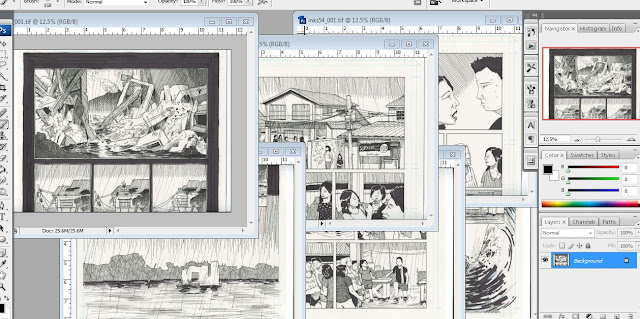
This part takes wayyyyy too long...
 

-Post Production


Finally onto the last leg of the process. Once I’ve built the comics in photoshop and have everything compressed, I then bring the files into Adobe Indesign and prepare them into a nice handy .pdf for clients. Even though it seems like a simple process, if done wrong you can completely destroy the comic when it is to be printed (speaking from prior experience). I make sure that I have plenty of conversation with the editor at this point to make completely sure that the file is exactly as what they want it to be. Mission accomplished.
 

Conclusion


I hope that this sort of tutorial helps people that are interested in producing and publishing creative non-fiction and journalist comics. It is a medium that has slowly been gaining traction as of lately and I deeply hope that it changes the minds and opinions of people who perceive comics as some sort of joke for the funny pages. If this tutorial helps you at all or you have further questions please let me know, and if this helps you in producing any comics like this be sure to post a link in the comments section as I’d love to read your work. Anyways good luck, fighting!


Wednesday, November 28, 2012

Symbolia Magazine Launch!


Hey everyone, I got some really exciting news about a new start-up publication set to launch on the iPad next month called Symbolia: The Tablet Magazine of Ilustrated Journalism. It's a monthly publication that fuses comics and journalism to bring interesting stories from all over the world for your viewing pleasure.


Erin Polgreen , co-founder of Symbolia, has this to say:

----
Our preview issue features illustrated and reported work by many of the amazing folks on this list: Susie Cagle, Sarah Glidden, Andy Warner, Lauren Sommer, Kat Fajardo, Chris A. Smith and Damien Scogin.

I'm writing today with an early request: Can you help get the word out next week? Your support will help push the entire comics journalism field forward and bring Symbolia closer to sustainability.

Here's why your support matters: I am committed to paying Symbolia's contributors, and am working to raise my rates to more competitive levels. Our main source of revenue right now is subscriptions. The more subscriptions we can sell in the first month of publication, the sooner we can raise rates and book more content.

More about Symbolia: Each issue of Symbolia is packed with ground-breaking, insightful stories by world-class illustrators and journalists, stunning infographics, video reports, exclusive audio, and more.

Founded by Erin Polgreen and Joyce Rice, Symbolia is available as an interactive iPad app and will be available as an ebook and via PDF subscription soon. Subscriptions to Symbolia are $11.99 for six issues, and single issues are $2.99.

-----
You can read more about Symbolia at:
The Chicago Tribune
The National
The Columbia Journalism Review

Be sure to support!

Friday, November 9, 2012

Elections are over...


Still alive here and been meaning to update lately, so here's a little teaser from a recent page. Pampanga, I miss you.

Wednesday, August 8, 2012

Going to Malaysia, out of work soon, comic exercise

Plans are all set and I'll be traveling abroad again for the first time in year, this time out to Malaysia for a little bit of journalism work and partially for vacation (first time ever?!). Hope to actually produce a comic coming up for a publisher in the next few weeks, so going to keep things under wraps until I can provide more information about that. But I promise this story is going to be a good one!

As far as an update on life, my contract with Taereung High School in East Seoul is coming to an end in two weeks and I still haven't found a job here in Korea. Things might be a bit tricky and I might have to take time off from the bigger book that I'm working on to tend to life problems. I know I keep talking about this "American Immigrant" novel and yet not showing that I'm producing any work for it, but trust me I'm almost already up to 50 pages penciled on it so far and I'm going to be inking in the near future.

Last thing is that I do want to show some art that I had originally did in university, got halfway done on, and gave up. Been sitting on my external hard drive for almost 1 1/2 years and I just took the rest of a day to sit down and finish it off. It feels so good to paint again after pencilling for months. So here it is, pulled from a small prompt I got out of Scott McCloud's "Understanding Comics" trilogy (a must read for all visual artists, not just comic artists). Goal was to tell an ambiguous story about a cop, a crook, and a third person and be a bit more complex and subtle at the same time in the storytelling. Figured to add another challenge by rendering the whole thing digitally. Originally had the story called "French 25," but looking back I'm not too crazy about the name, either way here it is...


Thursday, July 26, 2012

Korean Students, Wobbly Heads

Final days of being a teacher at Taereung High School are coming up, and definitely makes me sad to have to say goodbye to all of the students. During the last two days of the semester I got some time to do some painting demos for class (my students found out I can do more than just talk in English ;) ) and figured to show some of the better ones that came out. Enjoy!

The "So Mang Ban" Crew -- Taereung High School


Btw, even though people have been supportive of this idea of a weekly comic about recent grads, I haven't had ANYONE submit a story for it! Tell your friends, anyone that's grad recently that has to now pay off some student debt. Have a great day and see you all around.

Monday, July 16, 2012

Weekly Comic Idea about Recent Graduates

As we all know, times have been very tough for recent graduates who face a workforce that doesn't have a place for them, while saddled up with loads of debt that they can't possibly hope to pay off. Where people have been forced to move back with their parents, held off kids and marriage, and taken jobs that are well below their education level just to make minimum payments. Most of these people who are having to suffer through this feel like they have no voice to actually communicate their pleas to a great audience. Well...I want to try to communicate those voices.

Lately I've been tossing this idea around in my head and with a few friends, about doing a weekly small one page comic about people who have recently left university (through graduation or for other reasons.) Just something to tell others who they are, where they are from, and where their student debt has prevented them from going. I want to hear real stories, real events, from real people anywhere in the world. The idea is pretty small and I'm still contemplating how I want to work it out so that's why I'm posting today here in the blog. If you think you have a worthwhile story (or even if you don't but still want it told) please contact me here on my blog or email through my contact page. I want to make this a larger collaboration of people to bring awareness to a growing problem in our generation.