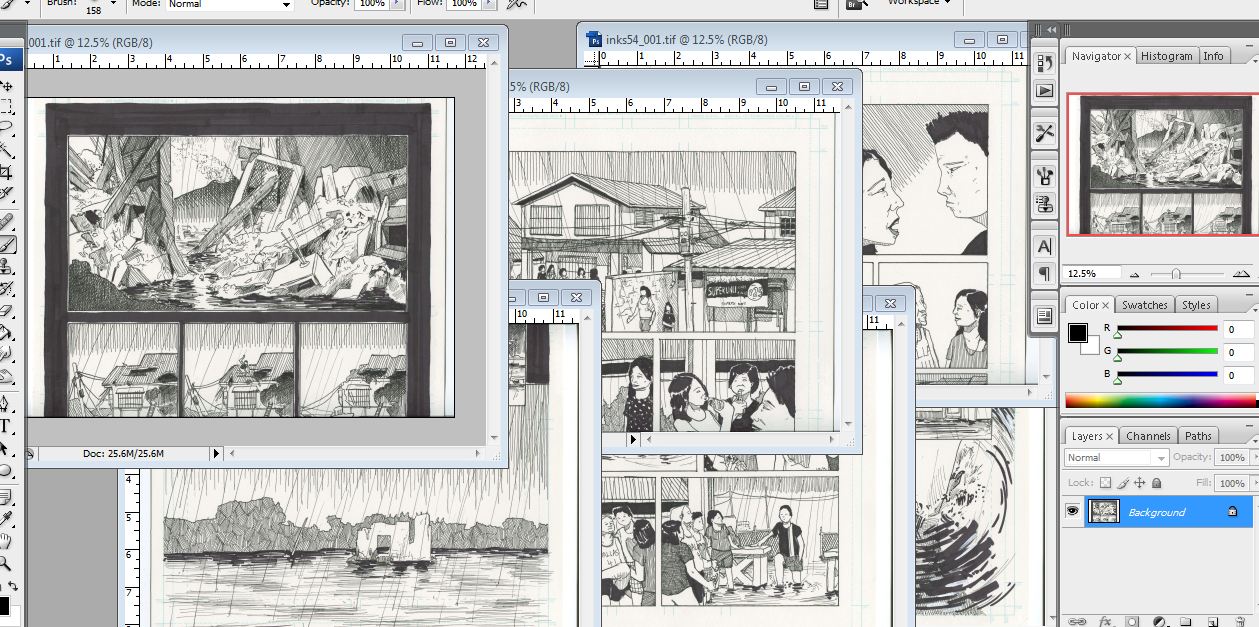
Throughout the time that I’ve been doing non-fiction comics, I’ve been asked quite a bit by writers, artists, editors, and a slew of other people about how I go from first sketches to finished product. It’s a very good question, mostly because when people think comics, they think that the medium is only able to tell fictional stories about superheroes and sorts.
People also have this idea that if you do tackle real events in the medium, that they are typically fall into the category of “political cartoons” and that the only type of storytelling is through satire. Perceptions also arise that because they are cartoons that they will appear as very quick sketches with no amount of detailed rendering at all. Well today I hope to try to answer some of these questions with somewhat of a brief tutorial on my process work.
This tutorial aims to do three things:
1. Make it easier for future editors of primarily prose publications who have never worked with a comic artist before to familiarize themselves with a rough guideline of what to expect.
2. To serve as a guide for beginning to advanced comic artists that are interested in experimenting with non-fiction/journalistic comics.
3. To help writers who are interested in presenting their work in comics and providing suggestions and tools in order to allow them to do so.
As far as my process goes, I try to break it down into 3 major sections, with 8 minor categories. This is just a rough guideline that I’ve found to work most effectively for me in comics, but keep in mind could change depending on the person. It also effectively keep a project organized and I’m able to tell an editor exactly how far I am on a project at any given time.
 |
| Pretty simple to follow, yet essential when working with more than one person. |
The following is a more detailed breakdown of the process of my comic making, hope you enjoy!
Writing
-Research
Because my work is primarily creative non-fiction/journalism, a great deal of research goes into my comics before I even put pen to paper. This research can be a number of things: conversations with local people, taking photos of the surroundings, and interviews with professionals in a variety of fields.
I always tend to keep three tools on me at all times: a small pocket notebook, a camera, and a voice recorder.
 |
| Low tech and fits in your pocket. Not pictured is the point-n'-shoot camera I use. |
I also take the advice from one of my writing professors back in university who would always say “Always keep a journal, because someday that journal might keep you.” In addition to this I’m an avid journal writer and typically write about a page a day about the events that happened in order to come back later when I do my novel work. Sometimes it’s the mundane things that you write about in journals that you’ll find more important later on that can really flesh out a story and add color to a scene.
 |
San Gabriel Road, Macabebe Pampanga. I used to walk
this road back home almost everyday. |
Also I try to be very involved in the subject that I’m writing about. For instance in the novel that I’m working on right now, it requires me to travel and live in three foreign countries and work in a field that I never went to school before or have had any real previous experience in. I have to not only learn how to teach, but I had to learn how to teach well. Remember all those papers that you used to have to write in high school about topics that didn’t really apply to you? Well, write what you know. And if you don’t know a subject, become involved with it so that you can understand it more. If you’re writing about baseball, maybe get on a field and actually learn how to play the game instead of making up information.
Finally, people always ask me why I typically don’t draw on location. My main reason is that when I’m doing research, I need to be engaging in my subject matter rather than be a spectator. This means that I need to actively be talking to people and gaining their story, as this is where the camera comes in handy. I can get 100 reference shots of different door designs, local dress, the tiling that is used in someone’s home, the complexity of telephone wires in an area, all around the same time that it would take me to do a drawing. While everyone works differently, I feel that the drawing part happens when I get back to the drawing table, not in the field.
-Draft
 |
| Example of a script from page 24 of The American Immigrant |
After all the initial research is talked about and recorded, I typically sit down and start writing a first draft in prose. The first part all I’m concerned about is dropping in important arcs of the overall story, doing straight writing without a concern for how any particular panel will look like. I go through and mark my reference where I have it that’s most relevant; along with how many pages I estimate a current story or chapter to be (subject to change, of course.)
After the first draft is finished, I go back and revise, starting to cut up my work and create breakdowns for each page. I keep in mind to try to left important breakdowns to end on the right page in order to create larger moments of closure on each page flip.
As I near the end of the writing, I go through and have this “1st draft” and script reviewed to make sure that it flows well. Once everything checks out at this point, we move onto the drawing…
Artwork
-Thumbnails
 Naw, not the ones attached to your hands, the sketch ones. My process for thumbnails has probably evolved the most over time than any other aspect of the art stage, originally from chicken scratches with pen on printer paper to now decent line and value studies in Photoshop aimed at around 10 x 15 inches. This is because I print my thumbnails out to the art size that I want to draw at, favoring a light table to make a transfer onto a clean piece of Bristol to complete my pencils faster and more detailed than without the transfer.
I also tend to make my thumbnails more detailed than a lot of comic artists, taking the time to make sure that everything visually flows and is set up at this stage before moving on. After completing my thumbnails I usually switch to another comic or artwork to let my thumbnails sit so I can go back and edit later. An extra hour spent on my thumbnails to fix corrections typically save me about 4 hours later down the road.
I’m also ok with breaking away from my draft a bit in order to get better flow and composition, but I’m always very careful to try to get exactly what I want at this point.
-Pencils
 Done with planning, now onto the real drawing stage of a comic. At this stage I’m using my reference very liberally in order to pull things from my previous research to accurately describe real people that exist in the real world. This is where having a ton of photo reference helps as I should have a fairly sizable library at this point to draw from. I think overall my pencils tend to be a little less tight than a lot of other professional comic artists, but this is mostly because I’m also inking the work myself and I can work with these pencils as my guideline for this. At this point characters and environments are more fleshed out, textures are noted, and designs are pushed out a little more.
I also work at a larger size (11x17 or about A3 size on pre-lined bristol) in order to get in all the detailed work that I want that I might not be able to do at the target print size. This also helps eliminate any small shakes of the hand or other small errors that might be apparently if I was to draw target scale. The tools I use are pretty simple, just a mechanical pencil and a couple of H regular pencils with a kneaded eraser.
-Inks
 Probably the most time consuming parts of my comics, because of the amount of rendering that I do with my inking. Using the same process as my penciling, I set up my light box to ink on another clean piece of Bristol board on top of my pencils. I used to be a crow quill and bottle ink guy (swore by the Hunt 102 nib) but as time passed and I found myself having to move often with my art supplies, I found pigment liners to suffice just as well. I’ve also moved away from spotting my fill blacks with a brush and just drop in my deep blacks with a black marker. Any mistakes I draw back into the page with normal correction fluid. People have asked if I’ve used a ruler for most of my work and honestly, I only use a T-square to lay in panel borders and such; I’ve mostly relied on drawing with my arm and locking my shoulder to get straight freehand lines. It takes practice but it’s very doable.
At this point I’m trying to put a tight final finish on my pages, making them essentially what I want them to look like if I was to print them exactly how they are at the time.
-Letters
Now to bring everything back into the digital world! I go through and scan my inks in at 300 dpi and set up the files to target print size (6.625 x 10.25 inches) and create separate layers for the lettering. The font sets that I use in my comics are actually based on my handwriting that I built previously and scanned in later, as to try to get a handwritten font that closely resembles my drawing work. Besides that I also freehand my borders and bubbles for my comics to give it that sort of journal feel to it too. Since I often work in foreign language (I speak multiple languages but I’m only a native speaker in English) I often mark anything that appears in non-English with a <………….> to come back later with a trusted translator.
I also choose to do lettering digitally over traditionally for one main reason, for fact checking and edits later that I may have missed. This is where you see essentially the “2nd draft” of the comic emerge. Peer reviews are done and everything is caught up at this point, and finally…
Editing
-Edits
This is where I get back with my editor and beta-readers in order to hash out problems with the dialogue and fact checking. This is where I aim to get a complete and final 3rd draft of the comic and prepare it to actually make it out to readers. I try to make sure that all my research is grounded with at least two sources for any major issue or quote, and this is where my translators come in and help to edit and make sure that my poor foreign language skills are touched up. Because most of the comic has been guided through every step of the way to this point, there isn’t much to do and not much is really changed at this point, but still extremely important.
 |
| This part takes wayyyyy too long... |
-Post Production
Finally onto the last leg of the process. Once I’ve built the comics in photoshop and have everything compressed, I then bring the files into Adobe Indesign and prepare them into a nice handy .pdf for clients. Even though it seems like a simple process, if done wrong you can completely destroy the comic when it is to be printed (speaking from prior experience). I make sure that I have plenty of conversation with the editor at this point to make completely sure that the file is exactly as what they want it to be. Mission accomplished.
Conclusion
I hope that this sort of tutorial helps people that are interested in producing and publishing creative non-fiction and journalist comics. It is a medium that has slowly been gaining traction as of lately and I deeply hope that it changes the minds and opinions of people who perceive comics as some sort of joke for the funny pages. If this tutorial helps you at all or you have further questions please let me know, and if this helps you in producing any comics like this be sure to post a link in the comments section as I’d love to read your work. Anyways good luck, fighting!